 Real Estate Tax Calc
What cap rate measures — and what it doesn’t
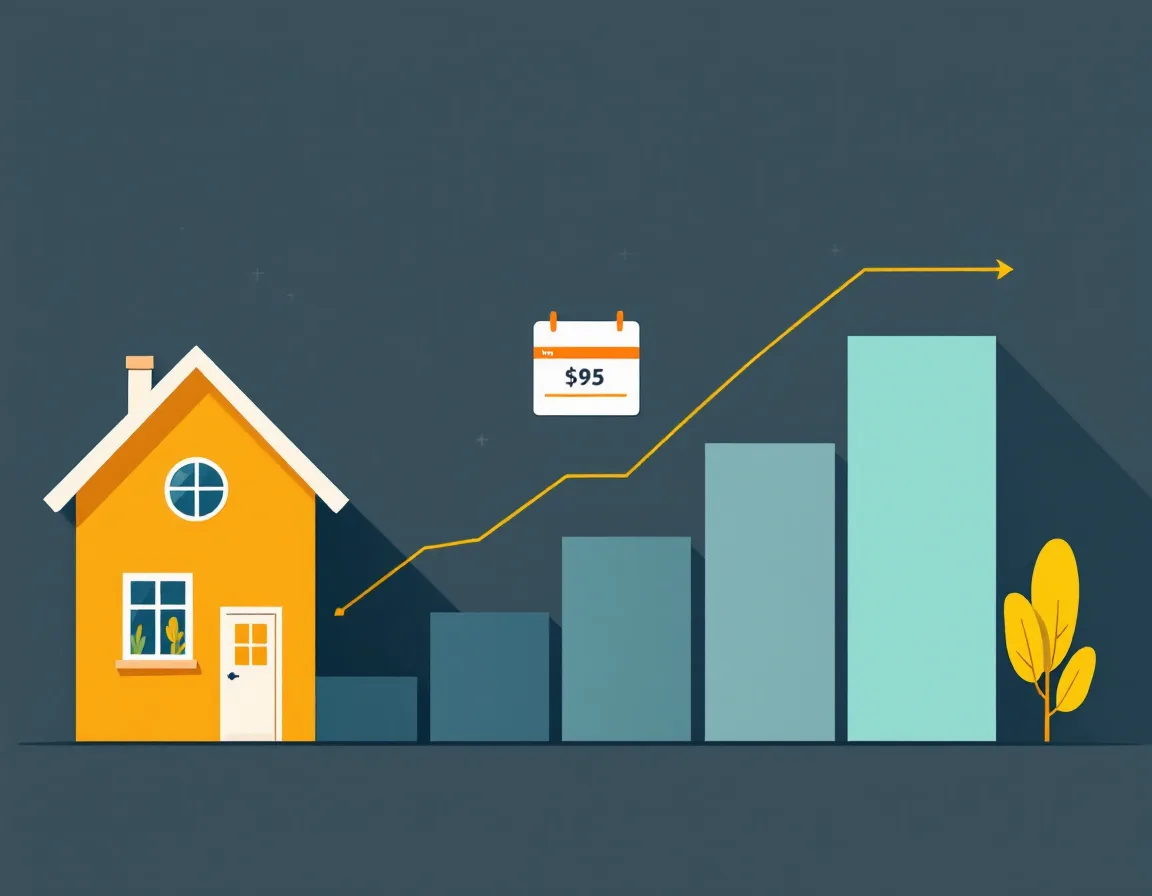
A capitalization rate (cap rate) is the ratio of a property’s net operating income (NOI) to its purchase price: cap rate = NOI ÷ purchase price. NOI is defined as gross rental income minus operating expenses — but before debt service (mortgage payments) and before income taxes. A $1,800,000 warehouse with $126,000 in annual NOI has a 7% cap rate.
What cap rate does not capture: the cost of financing (leverage), income taxes, depreciation benefits, or appreciation. Two investors buying the same 7% cap rate property can have very different after-tax returns depending on their tax brackets, their state of residency, and how they structure ownership. A California investor in the 9.3% income tax bracket and a Texas investor (no state income tax) buying the same Riverside warehouse at the same price have meaningfully different after-tax returns even though the pre-tax cap rate is identical. This guide focuses on the California tax effects that reduce the after-tax return from the stated cap rate.
Cap rates are used for property valuation (if the market cap rate is 6%, a property with $120,000 NOI should sell for approximately $2,000,000), for comparing investment alternatives (a 6% cap rate vs. a 5% cap rate suggests more risk or less quality at the lower rate), and for underwriting leveraged returns. They are a starting point for analysis, not an end point. Always compute after-tax, after-debt-service returns before making an investment decision.
Riverside Inland Empire commercial market — what drives cap rate levels
The Inland Empire — encompassing Riverside and San Bernardino counties, roughly 50–60 miles east of Los Angeles — has become one of the most significant logistics and industrial real estate markets in the United States. Its competitive advantages for e-commerce and distribution are clear: proximity to the ports of Los Angeles and Long Beach (the largest container ports on the West Coast), access to major interstate highways (I-10, I-215, I-15), relatively lower land and operating costs compared to coastal Los Angeles, and a large workforce. These fundamentals drove intense institutional demand for Inland Empire industrial real estate over the decade ending in the mid-2020s.
The result of this demand was historically compressed industrial cap rates in the Inland Empire. Institutional investors, REITs, and private equity firms paid premium prices for modern distribution facilities, driving cap rates on high-quality logistics assets significantly below what those assets would fetch in most other US markets. As interest rates rose starting in 2022, cap rates expanded from their historic lows, but industrial real estate in the Inland Empire remained in demand given the structural e-commerce tailwinds and the continued growth of same-day and next-day delivery logistics networks.
Riverside’s commercial market extends beyond industrial. Retail property in Riverside ranges from regional malls (facing secular pressure from e-commerce) to necessity-anchored strip centers (grocery, pharmacy, medical) that have performed more resiliently. Multifamily in Riverside has seen strong rent growth driven by California’s housing supply shortage and the relative affordability of the Inland Empire versus coastal markets. Each property type has its own cap rate range reflecting demand, lease structures, tenant credit quality, and financing availability.
How California income tax reduces your effective yield from cap rate
California taxes net income from commercial rental property at ordinary income rates that can reach 13.3% for the highest earners. Even at middle income levels, the applicable California rate is meaningful: 9.3% applies to taxable income from approximately $68,000 to $338,000 (2024 figures, subject to change), with higher rates above those thresholds. For most individual commercial real estate investors, California income tax will apply at rates between 7.25% and 13.3% on net commercial rental income.
The impact on cap rate analysis is direct. A $1,800,000 warehouse with $126,000 NOI (7% cap rate) generates net income that, after California income tax at 9.3%, becomes: $126,000 × (1 − 9.3%) = $114,258. This represents an after-California-state-tax yield of $114,258 ÷ $1,800,000 = 6.35%. The 7% cap rate becomes 6.35% after California state income tax alone, before considering federal income taxes. After federal income tax at 22%, the after-all-income-tax yield falls further: $126,000 − ($126,000 × 22%) − ($126,000 × 9.3%) = $126,000 − $27,720 − $11,718 = $86,562. After-all-income-tax yield: $86,562 ÷ $1,800,000 = 4.81%.
This comparison illustrates why a 7% cap rate in California does not provide the same after-tax return as a 7% cap rate in Florida or Texas. The California income tax — applied at ordinary income rates on commercial rental income, without the preferential rates California investors once hoped to use — represents a material ongoing cost. Investors comparing Riverside commercial returns to opportunities in zero-income-tax states must apply this adjustment to make an apples-to-apples comparison.
Proposition 13 and property tax on Riverside commercial acquisitions
California’s Proposition 13 caps the annual property tax rate at 1% of assessed value and limits annual increases in assessed value to 2% — until the property changes ownership, triggering a reassessment at current market value. This mechanism has profound implications for Riverside commercial real estate: a property that was purchased years ago by a long-term holder may carry a very low assessed value (and low annual tax), while a new buyer pays property taxes on the full current market value from day one.
For a new buyer of a $1,800,000 Riverside warehouse, property tax under Proposition 13 starts at $18,000 per year (1% of $1,800,000) plus voter-approved bond and assessment levies (typically adding 0.1% to 0.3% or more, depending on location). The total annual property tax for a new buyer might be $20,700 to $23,400 per year (including bonds), compared to a long-term holder of the same property who might be paying $5,000 to $10,000 based on their lower historical assessed value. This reset at purchase is a real cost that must be modeled into your NOI calculation when underwriting an acquisition.
Proposition 15, which would have reassessed commercial and industrial property to market value periodically regardless of ownership change, was rejected by California voters in 2020. Proposition 13’s protections for commercial property therefore remain in effect, and new buyers benefit from the same annual 2% cap going forward after their purchase-price assessment. But the purchase-price reset at acquisition — and the higher ongoing taxes compared to a long-held property — is a permanent feature of the California commercial tax landscape that affects your NOI underwriting and your modeled cap rate.
Commercial property depreciation in California — 39 years and no bonus
Non-residential commercial real estate — warehouses, retail, office — is depreciated over 39 years at the federal level using straight-line MACRS depreciation. This is a slower depreciation schedule than residential rental property (27.5 years). For a $1,800,000 warehouse with 85% building allocation: depreciable basis = $1,530,000. Annual straight-line depreciation over 39 years = $1,530,000 ÷ 39 = $39,231 per year.
This $39,231 annual depreciation deduction reduces federal taxable income below the stated NOI of $126,000. Federal taxable income: $126,000 − $39,231 = $86,769. At a 24% federal rate: $20,825 in federal income tax, rather than $30,240 without depreciation. The depreciation provides $9,415 in annual federal income tax savings — a meaningful benefit that is absent from the raw cap rate calculation. At California level, no bonus depreciation is available, but the $39,231 straight-line depreciation is deductible on the California return, saving $39,231 × 9.3% = $3,649 in California income tax annually.
A cost segregation study on a Riverside commercial acquisition can reclassify non-structural components (lighting, HVAC, parking lot, land improvements, certain fixtures) into 5-year, 7-year, and 15-year federal depreciation categories. On a $1,800,000 warehouse, cost segregation might reclassify $200,000–$400,000 of basis into shorter-lived categories, dramatically accelerating federal depreciation in the first five to ten years. At the federal level, bonus depreciation (under applicable law) could allow a significant portion of this reclassified basis to be deducted in year one. None of this accelerated depreciation is available at the California state level — California requires the addback of all bonus depreciation and applies straight-line over the regular MACRS life.
After-tax return comparison — California versus no-income-tax states
The total effective yield on a Riverside commercial investment, after all taxes, is best understood by comparing it to an alternative investment in a state with no income tax. Consider two otherwise identical $1,800,000 warehouses — one in Riverside, California and one in Dallas, Texas — each with $126,000 in annual NOI (7% cap rate):
Riverside scenario: annual NOI $126,000. Less property tax under Prop 13 (first year, approximately $20,700): net cash flow $105,300. Less California income tax at 9.3% on NOI of $86,769 (after depreciation): $8,069. Less federal income tax at 24% on $86,769: $20,825. After all income taxes: $105,300 − $8,069 − $20,825 = $76,406. After-tax yield: $76,406 ÷ $1,800,000 = 4.25%.
Dallas scenario: annual NOI $126,000. Texas property taxes are higher (no Prop 13 cap), estimated effective rate 1.8–2.0% in many Dallas-area markets: annual property tax $32,400–$36,000. Net cash flow after property tax: approximately $90,000–$93,600. No Texas income tax: $0. Federal income tax at 24% on $86,769: $20,825. After all income taxes: approximately $69,175–$72,775. After-tax yield: approximately 3.84%–4.04%.
In this comparison, Proposition 13’s property tax cap in California partially offsets the California income tax burden when compared to high-property-tax Texas. The relative attractiveness depends on property type, holding period, and whether future appreciation is expected. Long-term hold strategies in California benefit significantly from Prop 13’s property tax cap as assessed values grow slowly while market values appreciate.
Capital gains at sale of Riverside commercial property
Selling a Riverside commercial property triggers several layers of federal and California tax. Long-term capital gains (property held over one year) are taxed federally at 0%, 15%, or 20% depending on total income. Depreciation recapture on commercial property is taxed at a maximum federal rate of 25% (for the unrecaptured Section 1250 gain). California taxes the entire gain — including the recapture portion — at ordinary income rates up to 13.3%.
For the $1,800,000 warehouse held ten years and sold for $2,400,000: accumulated depreciation = $392,310 ($39,231 × 10). Adjusted basis = $1,800,000 − $392,310 = $1,407,690. Gain = $2,400,000 − $1,407,690 = $992,310. Of the $992,310 gain, $392,310 is recapture (taxed at 25% federal and 9.3%–13.3% California) and $600,000 is long-term capital gain (taxed at 15%–20% federal and 9.3%–13.3% California). Federal tax estimate: ($392,310 × 25%) + ($600,000 × 20%) = $98,078 + $120,000 = $218,078. California tax at 9.3% on $992,310 = $92,285. Total estimated tax at sale: $310,363. A 1031 exchange defers all of this — both federal and California taxes.
Common cap rate mistakes Riverside commercial investors make
Using forward NOI instead of trailing NOI in the cap rate calculation. Buyers who apply a cap rate to projected future rents (pro forma NOI) rather than current in-place rents can overpay. Particularly in markets where leases are at below-market rates, the “going-in” cap rate based on current rents may be lower than the property is marketed at. Always verify the in-place NOI with actual lease documents and estoppel certificates.
Ignoring California income tax in the return analysis. Many commercial investors focus on the cap rate without computing the after-California-income-tax return. At 9.3% to 13.3% California income taxes, the erosion from the stated cap rate to the after-tax yield is approximately 0.65 to 0.93 percentage points per 10% of NOI margin. This is a systematic error that consistently overstates expected returns for California commercial real estate.
Forgetting the Prop 13 property tax reset at purchase. A long-held property’s listed pro forma may use the seller’s current (low) property tax bill. Your tax bill after purchase will be based on your acquisition price, not the seller’s basis year. Recalculate property tax at 1% of purchase price plus bonds when building your own NOI model.
Assuming federal bonus depreciation benefit flows through to California. California does not conform to federal bonus depreciation. Investors who run pro forma returns assuming California income tax savings from accelerated cost segregation depreciation are making an error — those benefits are federal only.
Frequently asked questions
What are typical cap rates for commercial property in Riverside, CA?
Cap rates for commercial real estate in Riverside vary by property type. Industrial and warehouse properties in the Inland Empire have seen cap rates in the approximately 4.5% to 7% range depending on building quality, location, and lease structure. Retail cap rates range approximately 5.5% to 9%. These are general observations — transaction-level cap rates fluctuate with market conditions and should be verified with current broker data.
How does California income tax affect commercial real estate returns in Riverside?
California taxes net rental income from commercial property at ordinary income rates up to 13.3%. This reduces the after-California-tax yield from the stated cap rate by approximately 0.65 to 0.93 percentage points for every 10% of NOI, depending on the applicable bracket. A 7% cap rate in California has a meaningfully lower after-tax yield than a 7% cap rate in a no-income-tax state like Texas or Florida.
How is commercial property depreciated and how does it affect cap rate analysis?
Commercial real estate (warehouses, retail, office) is depreciated over 39 years using straight-line MACRS depreciation. The annual depreciation deduction reduces both federal and California taxable income below the stated NOI. Cap rates are calculated on pre-depreciation, pre-tax NOI, so the after-tax yield (accounting for depreciation’s tax savings) will differ from the raw cap rate number.
What is a good cap rate for a warehouse in Riverside?
There is no universal answer — it depends on your required return, financing costs, and alternatives. Historically, Inland Empire warehouse cap rates have been among the most compressed in the US due to strong e-commerce demand. A 5% to 7% cap rate for a well-located Riverside warehouse is typical in current market conditions. Compare the after-tax, after-debt-service return to your cost of capital, not just the raw cap rate.
Does California conform to federal bonus depreciation on commercial property?
No. California does not conform to federal bonus depreciation (IRC §168(k)). Any bonus depreciation claimed on the federal return must be added back on the California return, and California applies its own straight-line depreciation schedule. Cost segregation benefits are only available at the federal level for Riverside commercial investors, not at the California state level.
Educational information and estimates only. Not tax advice. Tax rules change and vary by situation; consult a qualified tax professional before acting.